
Proven Use Cases
People around the world trust Scala to build useful software. Popular domains include

Server-side
High-throughput HTTP servers and clients. Safe, scalable, and principled concurrency. Reliable data validation with powerful transformations.
Principled Concurrency
Scala's expressivity and compiler-enforced safety makes it easier to construct reliable concurrent code.
With Scala, your programs take full advantage of multi-core and distributed architectures, ensure safe access to resources, and apply back-pressure to data producers according to your processing rate.
One popular open-source option for managing concurrency in Scala is Cats Effect, combined with http4s for defining servers and routing. Click below to see other solutions.
libraries for Concurrency and distribution// HTTP server routing definition
val service = HttpRoutes.of:
case GET -> Root / "weather" => // route '/weather'
for
winner <- fetch1.race(fetch2).timeout(10.seconds)
response <- Ok(WeatherReport.from(winner))
yield
response
def fetch1 = fetchWeather(server1) // expensive Network IO
def fetch2 = fetchWeather(server2) // expensive Network IO
A Mature Ecosystem of Libraries
Use the best of Scala, or leverage libraries from the Java and JavaScript ecosystems.
Build with monolithic or microservice architectures. Retain resource-efficiency. Persist your data to any kind of database. Transform, validate, and serialize data into any format (JSON, protobuf, Parquet, etc.).
Whether you compile for the Node.js or Java platform, Scala's interop with both gives you access to even more widely-proven libraries.
Find the right library for your next Scala projectdef Device(lastTemp: Option[Double]): Behavior[Message] =
Behaviors.receiveMessage:
case RecordTemperature(id, value, replyTo) =>
replyTo ! TemperatureRecorded(id)
Device(lastTemp = Some(value))
case ReadTemperature(id, replyTo) =>
replyTo ! RespondTemperature(id, lastTemp)
Behaviors.same
Case Study: Reusable Code with Tapir
Harness the “Code as Data” Paradigm: define once, use everywhere.
Scala's rich type system and metaprogramming facilities give the power to automatically derive helpful utilities from your code.
One such example library is Tapir, letting you use Scala as a declarative language to describe your HTTP endpoints. From this single source of truth, you can automatically derive their server implementation, their client implementation, and both human-readable and machine-readable documentation.
Because everything is derived from a type-safe definition, endpoint invocations are checked to be safe at compile-time, across the frontend and backend.
Read more in the Tapir docs// type-safe endpoint definition
val reportEndpoint =
endpoint
.in("api" / "report" / path[String]("reportId"))
.out(jsonBody[Report])
// derived Docs, Server and Client
val apiDocs = docsReader
.toOpenAPI(reportEndpoint, "Fetch Report", "1.0.0")
val server = serverBuilder(port = "8080")
.addEndpoint(reportEndpoint.handle(fetchReport))
.start()
val client = clientReader
.toRequest(reportEndpoint, "http://localhost:8080")
val report: Future[Report] =
client("5ca1a-78fc8d6") // call like any function
Data Processing
Pick your favorite notebook. Run massively distributed big data pipelines; train NLP or ML models; perform numerical analysis; visualize data and more.
Big Data Analysis
Analyse petabytes of data in parallel on single-node machines or on clusters.
Compute either in batches or in real-time. Execute fast, distributed relational operations on your data, or train machine learning algorithms.
Work with popular storage and computation engines such as Spark, Kafka, Hadoop, Flink, Cassandra, Delta Lake and more.
Libraries for processing big data// Count the number of words in a text source
val textFile = spark.textFile("hdfs://...")
val counts = textFile
.flatMap(line => line.split(" "))
.map(word => (word, 1))
.reduceByKey(_ + _)
counts.saveAsTextFile("hdfs://...")Notebooks
Explore data in web-based notebooks and produce rich, interactive output.
Combine code, data, and visualizations in a single document. Make changes and instantly see results. Share and collaborate with others.
Along many cloud-hosted solutions, open-source notebooks for Scala include the almond Jupyter kernel, Zeppelin and Polynote.
Libraries for big data and visualisation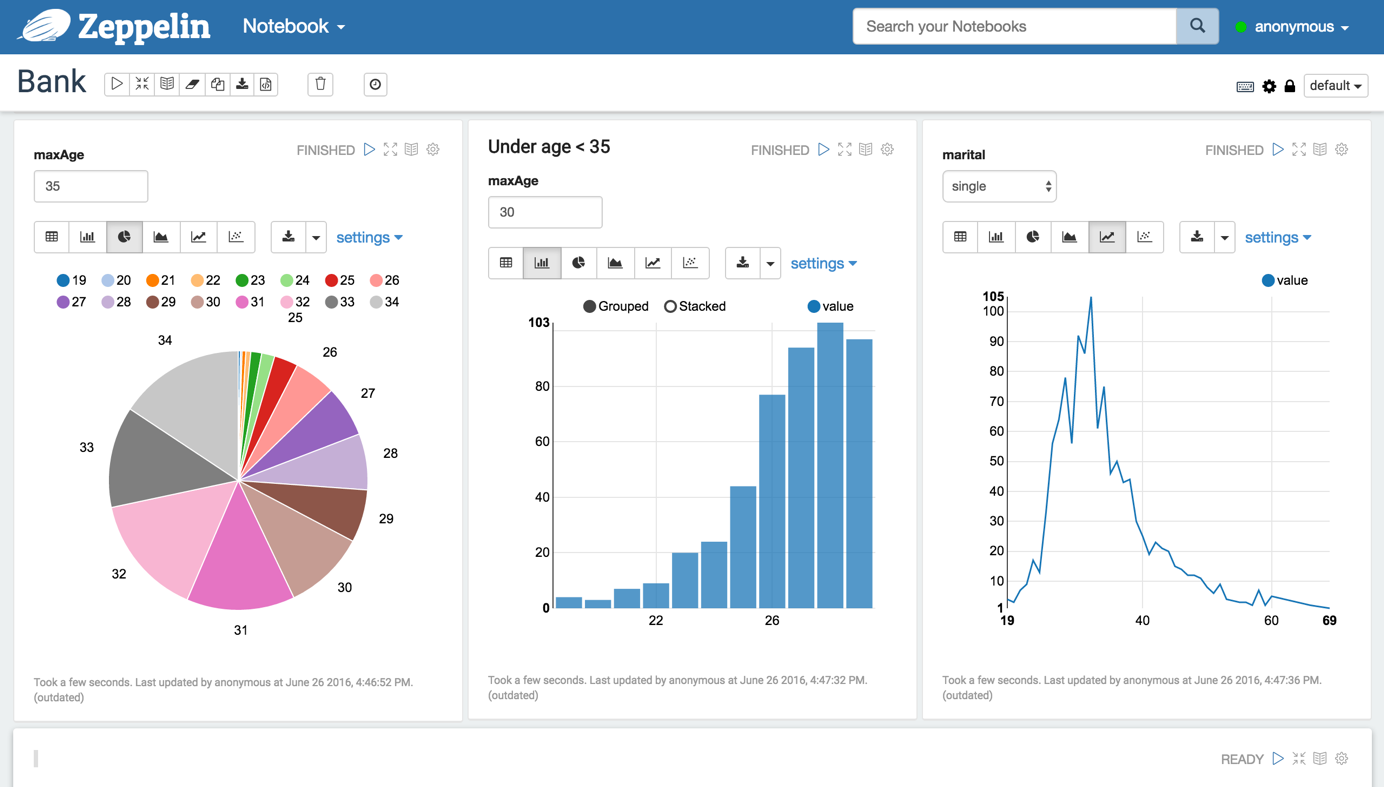

Command Line
Superpower your scripts with the Scala command. Get hands-on with the Scala Toolkit. Easily add libraries. Build CLI apps with instant startup.
The power of Scala in one file
Scala CLI gives all the tools you need to create simple Scala projects.
Import your favorite libraries, write your code, run it, create unit tests, share it as a gist, or publish it to Maven Central.
Scala CLI is fast, low-config, works with IDEs, and follows well-known conventions.
read more on the Scala CLI website//> using dependency com.lihaoyi::os-lib:0.9.1
// Sort all the files by size in the working directory
os.list(os.pwd).sortBy(os.size).foreach(println)$ scala-cli list_files.sc
/home/user/example/list_files.sc
...Get productive with the Scala Toolkit
The Scala Toolkit is a good fit for writing a script, prototyping, or bootstrapping a new application.
Including a selection of approachable libraries to perform everyday tasks, the Scala Toolkit helps you work with files and processes, parse JSON, send HTTP requests and unit test code.
Toolkit libraries work great on the JVM, JS and Native platforms, all while leveraging a simple code style.
find useful snippets in the Toolkit Tutorials//> using toolkit latest
// A JSON object
val json = ujson.Obj("name" -> "Peter", "age" -> 23)
// Send an HTTP request
import sttp.client4.quick.*
val response = quickRequest
.put(uri"https://httpbin.org/put")
.body(ujson.write(json))
.send()
// Write the response to a file
os.write(os.pwd / "response.json", response.body)Package to native, deploy easily
Package your apps to native binaries for instant startup time.
Deploy to Docker images, JS scripts, Spark or Hadoop jobs, and more.
other ways to package applications$ scala-cli --power package \
--native-image \
--output my-tool \
my-tool.sc
Wrote /home/user/example/my-tool, run it with ./my-tool
Frontend Web
Reactive UI's backed by types. Use the same Scala libraries across the stack. Integrate with the JavaScript library and tooling ecosystem.
Portable Code and Libraries
Write the code once and have it run on the frontend as well as on the backend.
Reuse the same libraries and testing frameworks on both sides. Write API endpoints that are typechecked across the stack.
For example: define your data model in a shared module. Then use sttp to send data to the backend, all while upickle handles seamless conversion to JSON, and also reads JSON back into your model on the backend.
More Scala.js libraries and frameworksenum Pet derives upickle.ReadWriter:
case Dog(id: UUID, name: String, owner: String)
case Cat(id: UUID, name: String, owner: String)// Send an HTTP request to the backend with sttp
val dog = Dog(uuid, name, owner)
val response = quickRequest
.patch(uri"${site.root}/petstore/$uuid")
.body(dog)
.send()
response.onComplete { resp => println(s"updated $dog") }Interoperability with JavaScript
Call into JS libraries from the npm ecosystem, or export your Scala.js code to other JS modules. Integrate with Vite for instant live-reloading.
Leverage the JavaScript ecosystem of libraries. Use ScalablyTyped to generate types for JavaScript libraries from TypeScript definitions.
Scala.js facades for popular JavaScript librariesval Counter = FunctionalComponent[Int] { initial =>
val (count, setCount) = useState(initial)
button(onClick := { event => setCount(count + 1) },
s"You pressed me ${count} times"
)
}
ReactDOM.render(Counter(0), mountNode)Powerful User Interface Libraries
Write robust UIs with the Scala.js UI libraries.
Pick your preferred style: Laminar for a pure Scala solution, Slinky for the React experience, or Tyrian or scalajs-react for the pure FP-minded developers.
See more Scala.js libraries for frontend and UIdef view(count: Int): Html[Msg] =
button(onClick(Msg.Increment))(
s"You pressed me ${count} times"
)
def update(count: Int): Update[Msg, Int] =
case Msg.Increment => (count + 1, Cmd.None)
case _ => (count, Cmd.None)Have another use case? Scaladex indexes awesome Scala libraries. Search in the box below.

Scala runs on the following platforms...



Ideal for teaching

Scala is ideal for teaching programming to beginners as well as for teaching advanced software engineering courses.
Readable and Versatile
Most of the concepts involved in software design directly map into Scala constructs. The concise syntax of Scala allows the teachers and the learners to focus on those interesting concepts without dealing with tedious low-level implementation issues.
The example in file HelloWorld.scala below shows how a “hello
world” program looks like in Scala. In Modeling.scala, we show an
example of structuring the information of a problem domain in Scala. In
Modules.scala, we show how straightforward it is to implement software modules with Scala classes. Last, in Algorithms.scala, we show how the
standard Scala collections can be leveraged to implement algorithms with
few lines of code.
Learn more in the dedicated page about Teaching.
@main def run() = println("Hello, World!")// Average number of contacts a person has according to age
def contactsByAge(people: Seq[Person]): Map[Int, Double] =
people
.groupMap(
person => person.age
)(
person => person.contacts.size
)
.map((age, contactCounts) =>
val averageContactCount =
contactCounts.sum.toDouble / contactCounts.size
(age, averageContactCount)
)/** A Player can either be a Bot, or a Human.
* In case it is a Human, it has a name.
*/
enum Player:
case Bot
case Human(name: String)// A module that can access the data stored in a database
class DatabaseAccess(connection: Connection):
def readData(): Seq[Data] = ???
// An HTTP server, which uses the `DatabaseAccess` module
class HttpServer(databaseAccess: DatabaseAccess):
// The HTTP server can call `readData`, but it cannot
// access the underlying database connection, which is
// an implementation detail
databaseAccess.readData()The Scala language is maintained by


The Scala Center is supported by